The table just needs a leg reattached, new hardware and a crack repaired. It’s an old table after all, though I don’t think of things of the 50s or 60s as particularly old. That was my childhood and I’m not old! In my mind, you have to date to the 1920s or earlier to qualify as an antique.
But what a move it was! What a thing moving is! Therapists, justifiably, rank it among the top three stressors in life, along with death and divorce. This however, I suspect does not apply to the average mover, who, according to our moving company, uproots every two years! Every two years!! How can that be? The only way to make sense of this is to figure that since those of us who stay in apartments as long as we had usually die in them, they are not represented in the statistics.
For those of us who do move after decades in one spot, besides the copious amount of time it consumes; the amount of decades-old dust one inhales opening up old stashes of papers and photos; the relentless decision-making that is required, like what to do with mom’s old meat grinder that brings back fond memories of making chopped liver at Thanksgiving but which no longer grinds and besides, I stopped eating meat long ago; besides all that, moving deserves its ranking among the top three stressors because of its environmental impact. Even though I took 20 boxes of books, twelve 39-gallon garbage bags of clothes, two enormous boxes of LPs, and 11 cartloads of old games, tennis rackets, exercise balls and a soda stream seltzer maker to be resold to raise money for the unhoused, we threw at least 20 large garbage bags full of junk into the trash. Then there was the bunk bed, futon, old bureaus, couch and kitchen etagere which the movers said they were taking to be recycled but which I suspect were merely added to mountains of waste that go unused.
The movers, though there was no way we could have managed without them, added to the stress. At moments in the four days our five to eight lives were entangled – the first day they came to take away all the furniture and so on to be “recycled,” the second day they packed up the kitchen, the third day they packed everything into their truck, the fourth day they delivered it all to our Vermont home – I muttered under my breath about the moving Nazis.
They were very efficient! They didn’t break anything. They were paragons of professionalism! But their relentless push and insistence on quick decisions – “Does this stay or go?” – all the time deeming us, I imagined, hopeless old codgers for our whimpered “yes,” to hanging on to some old chipped, ceramic serving dishes, old hangers and posters that had been rolled up in a corner for years, wore on us. We wish we’d made the move in the early days when the 53-year-old company had a psychotherapist on staff – the company boss’s mother.
Amid all the stress, there were moments of pleasure – discovering our son’s first baby teeth to fall out, neatly saran-wrapped; finding that my mother had written more letters to me in my lifetime than I’d remembered; finding letters from a treasured friend from before I unintentionally but irreparably damaged said friendship; finding letters from a friend who determinedly kept up contact despite my unresponsiveness from preoccupation; finding more letters from a dear friend who died recently and who I desperately miss.
There was also a certain joy, a sense of accomplishment, in the letting go. One night, a month before the final week of moving, I awoke to realize I was finally at peace with giving away a bunch of dresses that I had clung to, not least because of a yearning to be a knockout. In the letting go, I decided that even though I might still fit into the dresses, I, at 74, would look ridiculous in them.
It’d been more than 50 years since I’d worn the adorable white crepey dress embroidered with flowers that I still remember fighting with my father, outside the pricey Harvard Square boutique where I’d found the dress, about whether we could afford it. I can’t remember what the occasion was for which I insisted I needed it. It carried what I recall as the outrageous price tag of $50 at the time, which I’m guessing was 1969 or ‘70. It might have been for my high school graduation, but really, it was much too fancy and saccharine (speaking to the Julie Andrews in the Sound of Music-adoring aspect of my personality) to wear to the occasion at our hip, farm-on-a-hilltop school in southern Vermont. For some early college event? Or what? If I had a daughter, it was not at all clear she would want to wear it. It screams of more innocent, optimistic times, even though I wore it for sure when the Vietnam War was raging.
Then there’s the rich, red knit-wool, form fitting, long dress with wrist-length sleeves, puffed-up shoulders and accents of longitudinal ribbing, which my sister handed down. I could get into it, but it was designed for someone petite. I remember wearing it to a bar where there was to be dancing on a New Year’s Eve early in my marriage, when we were visiting my sister-in-law in South Dakota. I can still feel the embarrassment of wishing I looked spectacular, and knowing I looked all wrong and out of place. So why would I cling to such a dress? Our mother was a stickler for clothes fitting just right. This meant that on shopping expeditions, I spent many frustrating hours in dressing rooms with her, trying to find something that fit. But, her demanding standards imprinted on me. I have adhered to her principle throughout my life. It might be one reason I shop as little as possible. It takes much too much time. Perhaps keeping, and wearing the dress, was an act of rebellion. My mother stood over my shoulder, in my mind, reminding me it didn’t fit properly, but god-damn it, it was going to be ok.
My late-night epiphany also meant I could divest of another hand-me-down from my sister – a big skirted dress with flaring sleeves and embroidery that I think of as Mexican and I probably cherished because it brought me closer to my sister, who had sometimes served as in loco parentis but moved to southern California when I was a teen. I also could dispatch another woolen dress – this one also full-skirted, with swaths of shades of pastel purple – for which I paid more than I could afford in hopes of making a splash at the wedding of a childhood friend who was marrying every girl’s Sir Lancelot. There was also my own wedding dress. Although I still think it is pretty and tasteful, it was surprisingly easy to part with. I don’t have a daughter, so who would ever wear it?
(If I had any lingering doubts about giving the dresses away, they were decisively put to rest after my husband took pictures of me in them, before I carried them off to be donated. I looked way worse than ridiculous!)
There was also pleasure from the smiles I got from the dour and stressed New Yorkers I customarily saw toing and froing on our street when I tried to dispatch a wooden rocking horse that had stood mostly idle in our living room for 30 years. On the penultimate day of the move, I’d planned to ship the horse, which my mother had given my older niece when she was born 54 years ago and that my sister had sent us when ]our son was born, back to my younger niece in LA. Perhaps for if her children have children.
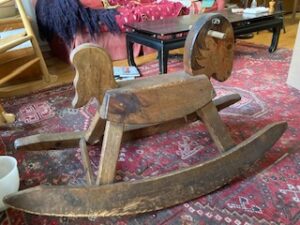
So, after the movers had taped up the last box, I set off to carry the 15-pound horse to the Fedex on our block, or, if I could make it the extra two long blocks, to UPS, which Google said tended to have lower prices. As I carried the critter out, our neighbor across the hall and the building superintendent commented on the age and handsomeness of the horse. By the time I got to Fedex, where I stopped because my angina was kicking in, several more people on the street had remarked on the horse’s singularity.
Fedex said it would cost $800 to ship, for the slowest method. As I waited for my niece to reply to my text asking whether she thought it was worth it, I got a call from the family taking the piano (see again, Our Momentous Move – Part 1) pleading with me to intervene with the super of our building who had turned their movers away because they were 3 ½ hours late. My phone battery was on red.
The Fedex person asked, remarkably even-temperedly, I thought, whether we wanted to ship the horse. My niece texted she’d consult with her sister. I called my husband to ask him to intervene with the super. I leaned over on the counter and took deep breaths to try to dispel the angina. Minutes passed. The Fedex person said actually, they could do it for $400. I texted my niece. She said do it for $400. My husband called to say the super said, “No way.” We were planning to vacate the apartment and head to Vermont at 2 p.m. the next afternoon. I imagined the people who I assumed would come to demolish the decrepit apartment and turn it into a multimillion dollar condo the moment we closed the door for the last time, chopping up the piano into little pieces and carting it away in a dumpster.
I told the Fedex person it was a go. Wrap up the horse. I paid and went off to dinner with a friend. As I sat down, I found a voicemail from Fedex saying they’d made a mistake and it was actually going to cost $700 and to call them right away. My phone battery showed a last sliver of red. I despise people who make calls on their cell phones while dining with others. I wasn’t going to do it. Could Fedex charge me the additional $300 without my authorization? I couldn’t believe they could, but in this age of no regulation under Trump, I thought they could probably get away with anything. I would deal with it in the morning.
After a final breakfast at our corner bagel place, I arrived at Fedex as an employee was struggling to open the bottom locks of the store’s swinging glass doors. The horse was still there, they cancelled my credit card charge. UPS quoted $600+ over the phone. Give it away, my niece texted. It’s going out to pasture, along with the sheep, I texted back. (We have five sheep at our place in Vermont.) I threw the horse under my arm and took her home. More comments on the street about what a beautiful old horse she was. As I got off the elevator, our neighbor across the hall, always a wit, asked why I was still carrying the horse around. We laughed, he gave me a kiss on the cheek and wished us a good life in Vermont.
Later that afternoon, ten minutes before we had to leave, the piano movers arrived. I didn’t cry. I had said, “Goodbye, I love you,” to the piano, shortly before the movers were supposed to have arrived the day before. They wrapped it up in many blankets, got it out the door, but then couldn’t fit it into the elevator. I had to go to do a last errand.
“Tengo que irme,” I said to the crew, all of whom were Spanish speaking. They ignored me. I feared that when I returned, the piano would be back in the apartment, though they didn’t have the keys, or sitting abandoned on the landing.
 Neither happened. Somehow, they’d gotten the piano into the elevator. Several hours later, when we were on the road to Vermont, I got a text from the family that took the piano and a picture of it moved into their living room. They said they were so happy and thanked me. I was happy too, and told them so.
I’m expecting my episodic angina to fade away, or significantly diminish, as a result of having accomplished the move. But we still have to unpack. Our house looks like Homer & Langley’s. We can barely move around. And, while we can break down the boxes, what are we supposed to do with all the unprinted newsprint the mover used for wrapping every last tchotchke?
N.B. It turns out, if I can figure out how to get my hands on an industrial-scale shredder, I can use the paper for sheep bedding. If so, it would be a bonanza since the late summer drought has made hay particularly expensive this year.